The practice ground
Selling is the only craft with nowhere to practice.
parable is a roleplay simulator for sales calls. Your reps call a virtual customer directly in the browser. The customer interrupts them, raises objections and doesn't accept every argument. On this page, we explain in detail why we built parable the way we did.
For as long as there has been selling, reps could only practice properly in one place: on a call with a real customer. Those calls always involve money and responsibility, which makes relaxed learning almost impossible. So we spent more than two years building the room that was missing. There, your reps have calls with customers who behave realistically, with nothing at stake. Your real customers then talk to reps who have already practiced.
From the team that built it · Schwarzschild AG, Rotkreuz
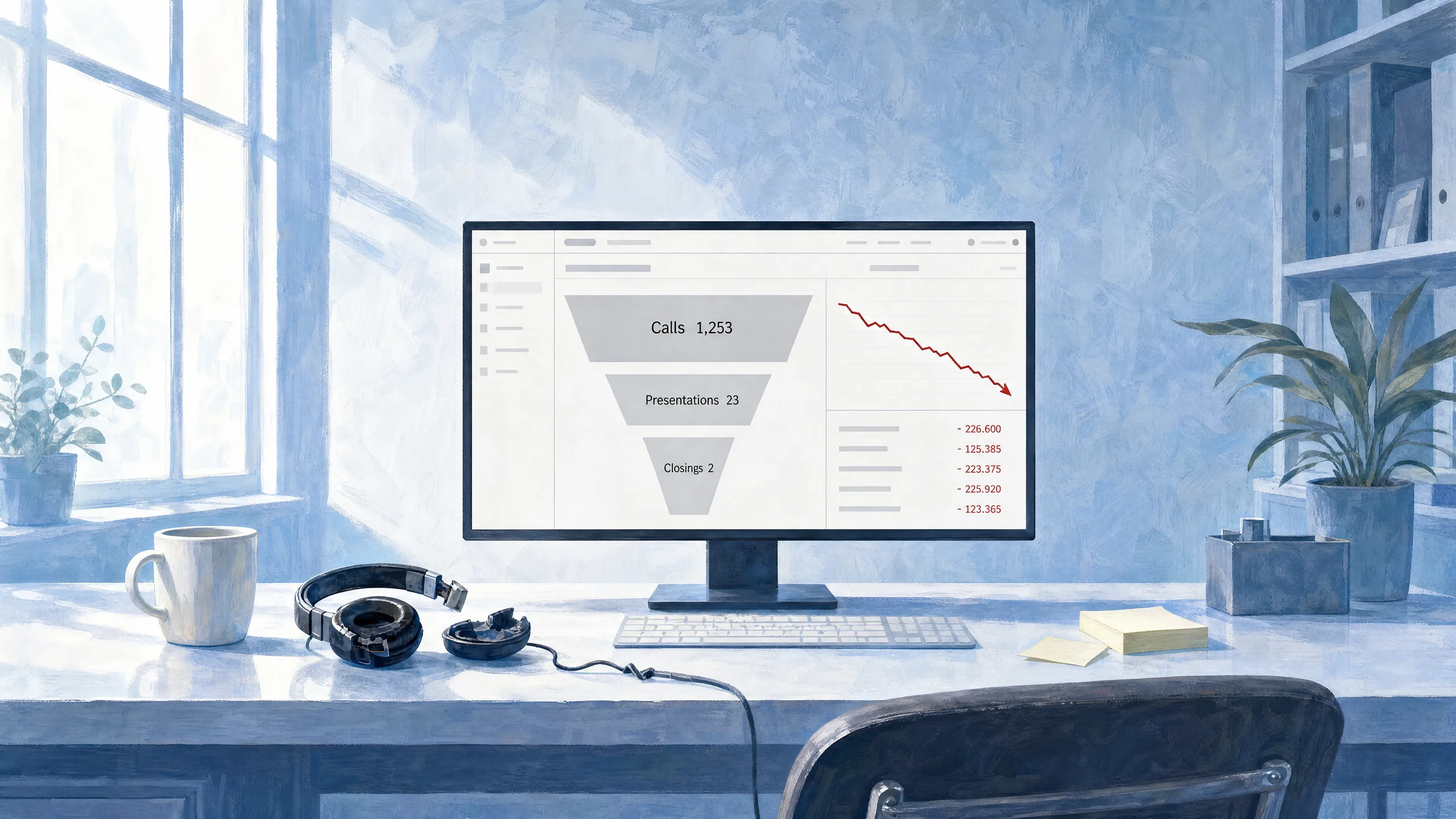
The missing room
Every other craft has a place where mistakes are allowed.
A carpenter can practice on old boards. A pianist can play alone at home on a Tuesday afternoon, as often as she likes. A pilot can crash a plane in a simulator and start again a moment later. A sales rep, on the other hand, has a phone, a name on a list and a real person on the other end, someone they can't afford a bad call with.
That's why sales is almost always learned on real customers. A new rep makes their first 100 calls to real customers, who deserved an experienced contact and never agreed to act as training partners. Experienced reps face the same problem whenever they learn a new method, sell a new product or approach a new audience. They, too, can only try it out on a real call, and every failed attempt costs a lead.
Many people think selling is a matter of talent. That's a misconception. Someone who sells well without experience is called a natural. Usually, though, that person picked up individual communication skills earlier, from family, friends or other jobs, and uses them without realizing it. Nobody is born a salesperson, and selling can be learned like any other craft. New reps in particular often see it as talent anyway. If they sell little in their first weeks, they quickly decide they aren't cut out for it and give up, when all they lacked was training. Your company loses twice: first the leads from the failed calls, then reps who would have become good with training.
Common training formats help only to a limited extent. Usually they mean a seminar day, a roleplay with colleagues, or a manager listening in on calls. We know these formats well, because we attended seminars and coaching sessions ourselves for many years. Roleplays are good for practicing the most common objections. But a colleague can only partly behave like a real customer, and the variety of real calls is missing. When a customer says something unexpected, the rehearsed pattern stops working. And when a manager listens in, there's a real customer on the line again. Until now, there was no room where reps could practice realistically and without consequences.
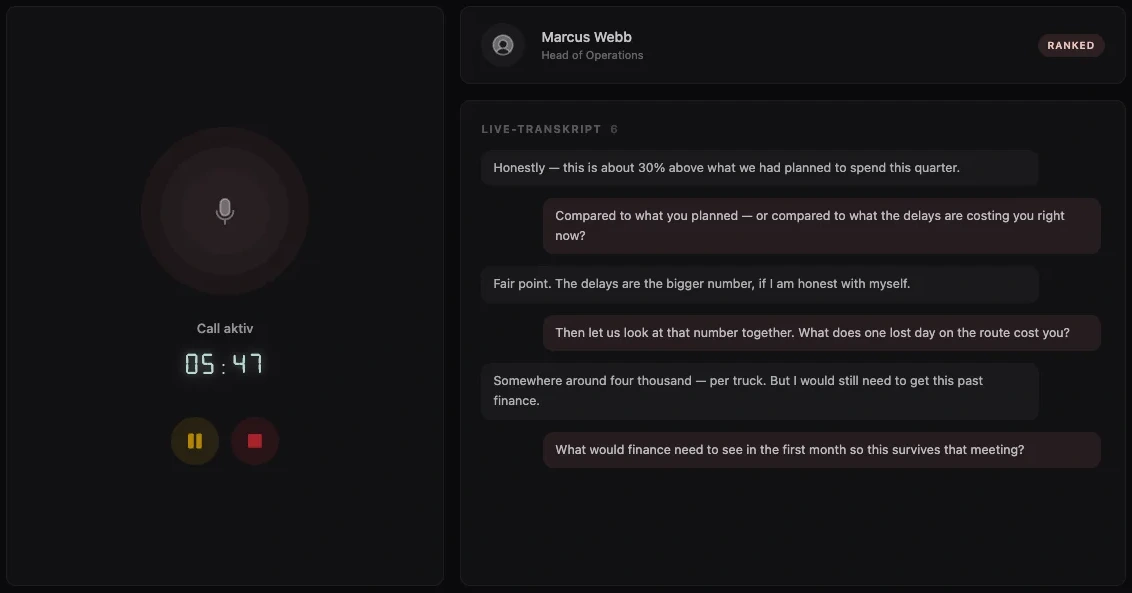
Permission
Here, a lost call costs nothing.
Tuesday, 11:40 am. One of your reps goes for the close, although they should have asked the customer two more important questions first. The customer pulls back, gives only short answers and ends the call. The deal is lost.
But the call took place in parable, so the mistake has no consequences. No lead is lost, nobody has to explain to a manager what went wrong, and on Monday nobody asks how the account is coming along. At 11:47 am, the same rep makes the same call again and changes a single sentence.
What reps fear most is rejection.
The problem is the outcome of the call and everything that follows from it. Once those consequences disappear, reps dare to step away from their usual approach. Many try phrasings they would avoid on a real call, address objections more directly or become more personal. A rep might hold on where they would otherwise have given in, and let a pause in the call stand until they see what the customer does with it.
This way, parable gives reps permission to make mistakes and learn from them. To your customers, they then bring what worked in practice.
Why a game
Nobody practices something 300 times just because it's sensible.
Sales teams rarely practice through deliberate repetition, even though every craft depends on it. A carpenter repeats the same cut until it's right. Roleplays, by contrast, need preparation, a fixed appointment and colleagues who have time. So they rarely happen, and by the next one a rep has forgotten most of the hurdles from their daily work. Hardly anyone writes down where they got stuck in a call.
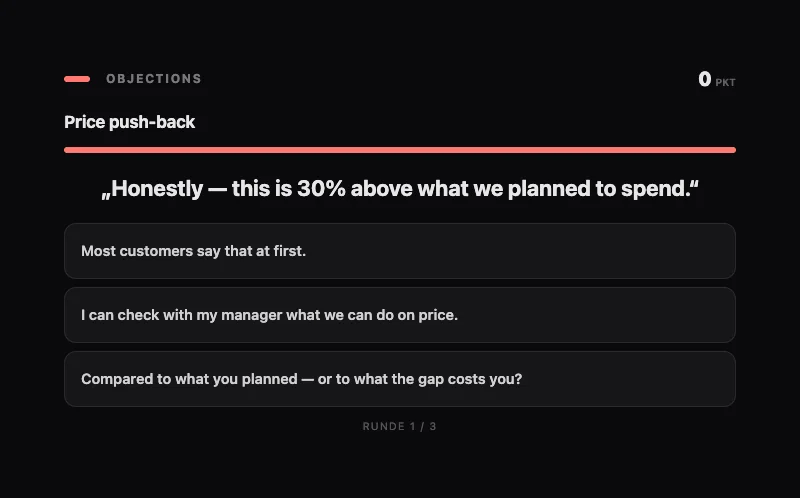
That's why we had to design training that reps want to come back to on their own. parable has a rank that changes continuously and new areas that unlock only once they've been earned. After every call, parable analyzes where things went wrong and suggests matching short exercises. Each one takes seconds: the rep gets an objection and picks the best of three answers under time pressure. That way, they work on the problem that just happened while it's still fresh.
A rep might, for example, fit in three short exercises seven minutes before a meeting. Nobody told them to, and no manager had to remind them.
Rank and short exercises look like a gimmick at first glance. But this is the part we worked on longest, because it makes sure training happens regularly. Without it there would be no repetition, and without repetition nothing else on this page would work. For you, this means training happens without you having to organize it or remind anyone.

Ascent
Calls get harder because your reps get better.
Every rep starts with easy calls. Nobody faces the toughest customer on day one, and nobody stays at beginner level for good.
Which customer comes next depends on the last call, not on a fixed curriculum. A rep who handles the price objection well twice, for example, won't get it so easily afterwards. It then comes later in the call, from a customer who is more patient and has better arguments. This way, every rep on your team trains at their own level, from beginner to seasoned pro.
A good sales call rests on 22 methods. Their foundation comes from coaching sessions and seminars we started attending about six years before parable began. This includes NLP training up to master level. NLP is a widely used approach in communication training. Before development, we also studied the professional literature closely and read more than 300 books on sales and conversation. From this knowledge, our own experience and more than 150 measures for assessing a call, we derived the 22 methods we currently consider fundamental. They won't be the last.
For each rep, a wheel shows how well they have mastered each of the 22 methods. It fills only where a method was applied successfully, which is why it is meaningful. In parable, harder calls are a reward for good performance, not a punishment for mistakes.
The opponent
The biggest opponent is forgetting.
Three weeks ago, one of your reps lost a deal because of a single sentence in the fourth minute of the call. They don't know which sentence it was. The customer didn't say, and customers almost never do. Usually they politely say the budget is tight right now, and the call is over.
Over a whole career, forgetting hurts a rep more than difficult customers do. An insight is there for an afternoon and then gone. The same mistake happens in March and again in September. And there's usually no time to debrief a call.
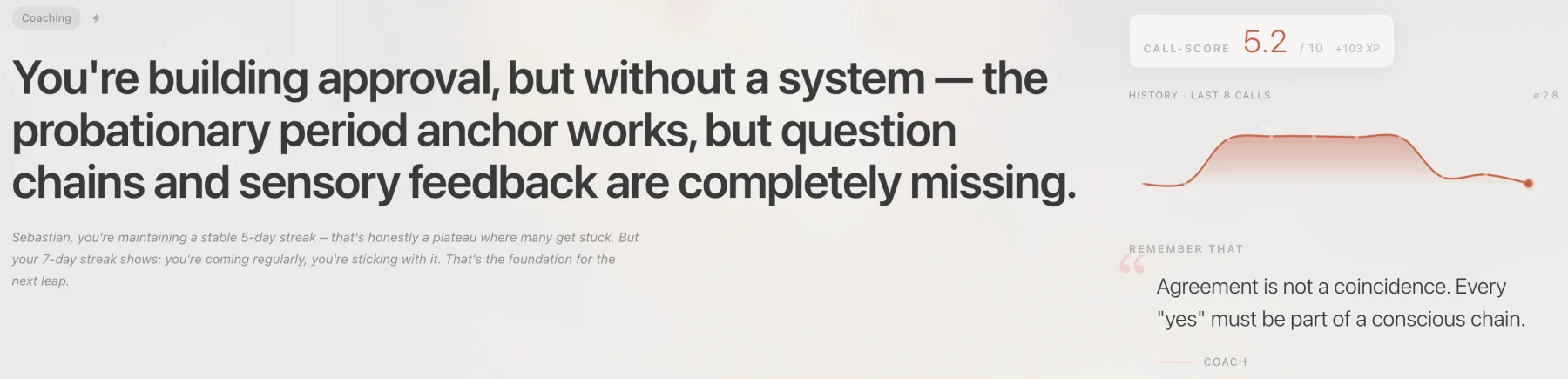
That's why we built parable so that insights last. Calls are saved, and every sentence is marked where it was said. That includes the sentence that won the customer over and the one that lost them. There's also a coach that knows all saved calls. Your rep can ask it questions, even at 11:40 pm, by typing or by voice. A mistake they have understood once is less likely to cost you a second deal.
That's also where our name comes from: a parable is a short story you draw a lesson from. What matters is the lesson; the story is just the way to pass it on.

The return
In the end, what counts is that your rep has mastered the craft.
We are working toward a specific moment. One of your reps has an important call with a real customer, and it isn't their first attempt. They have had a call like this before, in a room where mistakes cost nothing.
That's what we built parable for. We're not trying to beat quotas or defeat the customer. The customer isn't an opponent, and after more than two years of development, that's still the principle that matters most to us. A rep who feels confident doesn't need to push. Your customers notice that.
The rank is only a tool, much like scaffolding. It makes sure practice happens regularly. When a rep eventually stops noticing it because practicing has become second nature, the rank has done its job.
Your reps leave parable with the confidence of having been in a situation before, instead of only knowing a memorized script.
Pricing and availability
parable runs directly in the browser. You don't need to install anything, and your reps practice whenever it fits their day. Billing is per user, bundled for the whole organization. A team of 5 reps uses the same plans as a sales department of 50.
The number of live calls that can run at the same time is technically limited. That's why we open new seats step by step. This is the only reason for the waitlist; there is no artificial scarcity.
From €107 per user and month, billed yearly.
€129 monthly · three plans · cancel monthly plans any time